When the Cranes Come Down
You can read the health of an entire economy by counting the cranes against a Boston sunset. The count has fallen from around twenty to single digits. The cranes themselves were never ours — they are made in Germany, shipped through the harbor, and rented by the month. What happens up the supply chain when they come down tells you everything about who survives a downturn, and why a kept record is the only thing that holds its value when the iron does not.

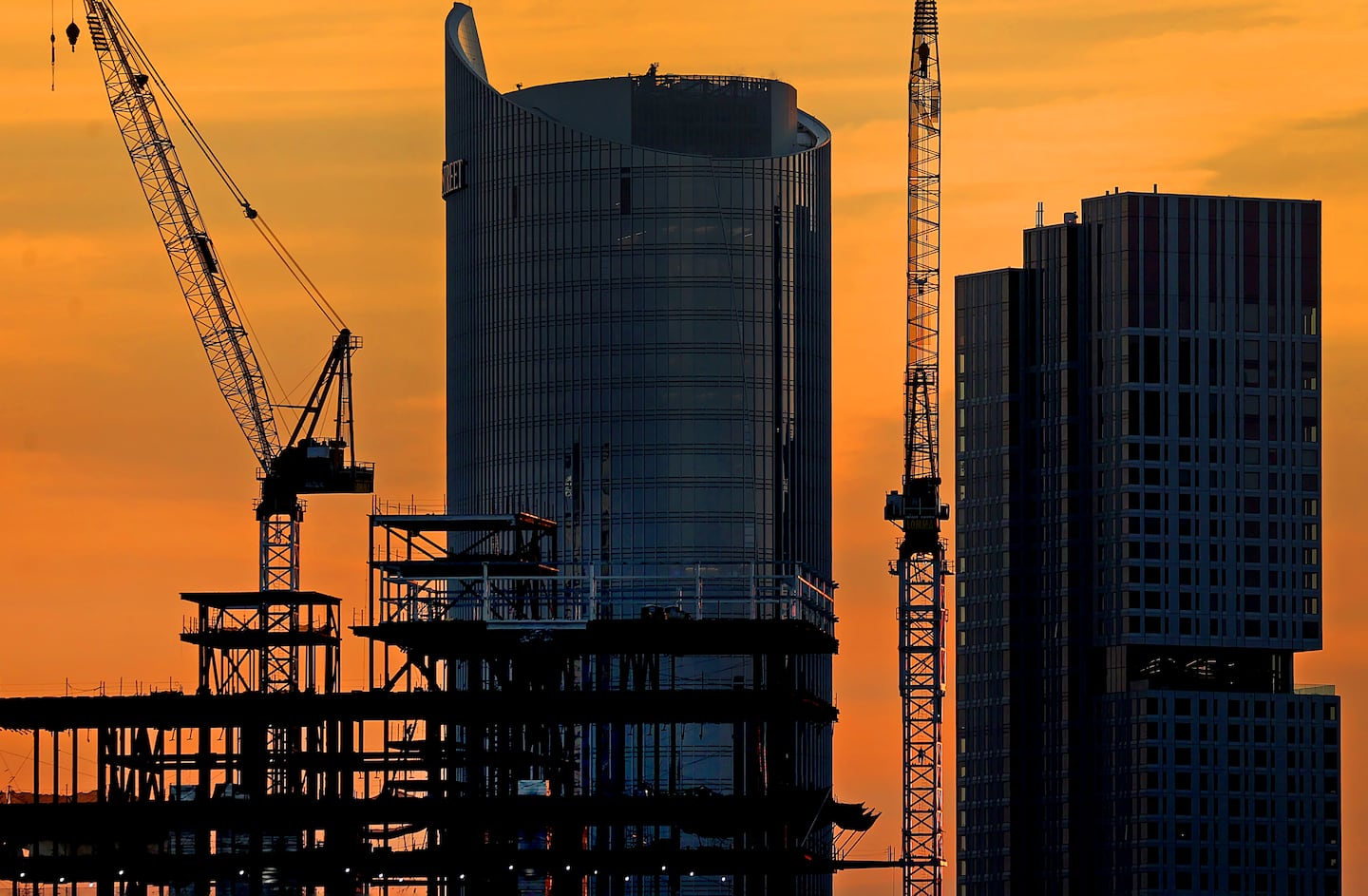
Stand on the harbor side of Boston at the right hour and the skyline does something honest. The sun drops behind the towers and the glass goes black, and what is left in silhouette against the burnt-orange sky is the truest economic instrument the city owns: the cranes. Count them. For years there were around twenty of them stitched across downtown and the Seaport, slow red lights blinking at their tips all night. Today you can count them on your hands. The crane count has fallen to single digits, and that single number says more about interest rates, capital, and confidence than any quarterly report. A crane is a bet someone made that a building would pay off. When the bets stop, the cranes come down first.
I have spent a lot of time lately thinking about those silhouettes, because they are the most visible edge of an industry almost nobody outside it understands. We see the tower crane as a fixture of the skyline, as permanent as the buildings it raises. It is the opposite of permanent. It is rented, often by the month. It was built on another continent. And it is the very first thing to disappear when the money cools. To understand what is happening to Boston right now, you have to follow the crane backward — all the way to where it was made — and then forward, into what happens to the people who make, move, and lease it when the building boom flattens.
The crane was never ours
Here is the fact that reframes everything: the cranes that define the Boston skyline are not American, and they are certainly not local. The heavy tower cranes lifting steel over downtown are overwhelmingly European — Liebherr and Wolffkran out of Germany, Comansa out of Spain — engineered and fabricated as modular components an ocean away. The closest domestic source for the technology is Manitowoc's Potain line in Port Washington, Wisconsin, which builds some components and self-erecting models, and even that is most of a country away. The tower crane is an import. It arrives the way everything heavy arrives: by sea, through a deep-water port, broken down into sections, where regional logistics distributors take custody and trucks haul it to the site to be assembled into the thing you see against the sky.
So before a single beam is ever hoisted, the crane has already run the full relay of the built economy. It was manufactured. It was distributed. It is owned by a leasing firm and rented to a contractor. It is, itself, a manufactured-distributed-owned-leased object — the same four-leg journey that every beam, every appliance, every window in the finished building will travel. The machine that builds the supply chain is the supply chain, made tall enough to see from a mile away. That is why it is such a clean barometer. When you watch a crane come down, you are not watching one machine leave a job. You are watching a decision ripple backward through a manufacturer in Germany, a distributor at the port, and a leasing firm somewhere carrying debt on iron that is no longer earning.
Why Boston was never going to be a forest of towers
It helps to remember that Boston was never built to hold a hundred cranes at once. Unlike the cities that sprout supertalls, Boston has hard, permanent ceilings on how high it can go. Its proximity to Logan means the FAA caps structures at roughly seven hundred feet downtown and nine hundred in the Back Bay — you cannot build into the approach path of an international airport. Layered on top of that is some of the most protective historic-preservation zoning in the country, which has deliberately deterred the supertall skyscraper for generations. And beneath it all, literally, is the problem of the ground itself: much of the city sits on marshy, reclaimed land, where deep foundations are expensive and slow, and where highly organized neighborhood opposition turns approvals into multi-year campaigns.
Boston's skyline is constrained by physics, by law, and by its own marsh. So when a downturn lands here, it lands on a market that was already vertical only in carefully chosen places — and the cranes thin out fast.
The result is a skyline of sporadic, targeted infill rather than expansive mega-projects. The few cranes still working are doing precise, high-value work — the kind of tight-site jobs in Kendall Square and downtown where the trend runs toward high-tech electric self-erecting cranes, and the kind of specialized lifts the Citgo sign refurbishment in Kenmore Square requires. Fewer cranes, but smarter ones. That is the shape of a constrained market in a cooling cycle: not a crash so much as a quiet, deliberate retreat to only the work that genuinely pencils out.
What happens up the chain when the boom flattens
When new project starts evaporate, the pain does not stay on the empty lot. It flows backward up the supply chain in three distinct shapes, and each link responds differently to survive. For the manufacturers, new equipment orders fall off a cliff, so they pivot instantly from selling iron to servicing it — idling assembly lines, aggressively pricing OEM parts and certified repairs, and convincing fleet owners to refurbish older models rather than buy new. The smart ones use the downtime the way a fabricator like Apex Fabrication uses a slow season: investing in the next-generation product, engineering the electric self-erecting cranes that will lead the next cycle. Survival as a manufacturer means monetizing the fleet that already exists in the world.
For the distributors — the firms that took custody of those modular sections at the port — the threat is the inventory sitting on their lots, financed with floor-plan debt that compounds whether or not anything sells. So they slash margins to liquidate new units, open in-house service bays to capture steady maintenance revenue, and transition toward used-equipment brokerage, earning commission as intermediaries without carrying the balance-sheet risk themselves. The distributor's whole game in a downturn is to stop being a warehouse of depreciating assets and become a service-and-brokerage operation that earns on movement rather than on holding.
The first is what the industry calls the ghost fleet. A crane cannot simply be parked in a field and forgotten. Even sitting idle and earning nothing, it requires strict, ongoing regulatory inspections and continuous anti-corrosion maintenance. It bleeds cash while generating zero revenue — a fleet of expensive ghosts that must be fed. The second trap is worse: as everyone de-fleets at once, the used-crane market floods, and the resale value of every firm's fleet plummets. That collapse in collateral value can trip the covenants on a leasing firm's bank loans, forcing them to post more cash collateral to lenders at the exact moment their revenue is lowest. The downturn does not just slow them down. It can liquidate them through their own balance sheet.
The survivors play a global game. They initiate reallocation — moving unrented cranes out of depressed markets like Boston toward regions still spending on infrastructure. They de-fleet aging units through specialized heavy-machinery auctions to pay down debt fast. They offer flexible, short-term, and rent-to-own contracts to hold a base of utilization. And above all, they pivot away from speculative high-rise residential toward the work that does not care about interest rates: government-backed civil engineering, bridges, and energy infrastructure. When the private towers stop, the public works become the lifeline.
The asset that holds its value when the iron does not
Here is where my work and the crane business meet. Notice that almost every survival move in a downturn is, underneath, a question about a record. A manufacturer selling refurbishment needs to prove a machine's service history. A distributor brokering used iron is selling, more than the metal, the documentation that says what this crane is and what was done to it. And a leasing firm staring down a covenant call is being destroyed by a valuation problem — a flooded market where no one can tell a well-kept crane from a neglected one, so they all get priced like ghosts. A flooded used market is not only a price crisis. It is a provenance crisis. The firms that lose the most are the ones who cannot prove what they own.
When everyone is liquidating, the only crane that holds its value is the one whose entire history can be proven. Provenance is the asset that is worth the most precisely when everything else is worth the least.
— The counter-cyclical case for the record
This is the whole thesis of what we are building at Propreti, seen through forty stories of steel. The relationships and the records are the durable assets — not the iron, which depreciates, and not the boom, which always ends. A contractor like Meridian Builders that can show a verified history of every lift, an owner like Keystone Property Management that holds a complete provenance record for the building a crane raised, a broker like Harbor Realty Group that can prove the lineage of an asset to a buyer — those are the parties who do not get repriced like ghosts when the market floods. They have a kept record, and a kept record is the one thing a downturn cannot devalue. The cycle punishes everyone who was trusting memory and rewards everyone who was keeping proof.
The cranes will come back. They always do — the next cycle is already being engineered in those quiet Wisconsin and German factories as electric, precise, and smarter than the last. When the money warms, the iron will come back through the harbor, the distributors will take custody, the leasing firms that survived will redeploy, and the silhouettes will multiply against the sunset again. What I want to change before then is not the cycle. The cycle is older than all of us. What I want to change is the record. Right now, when the cranes come down, the proof comes down with them — scattered, lost, rebuilt from scratch on the way back up. It does not have to. The skyline can fall and rise. The record should never have to be rebuilt.
Verified in this story
The makers named above, connected to their verified work.