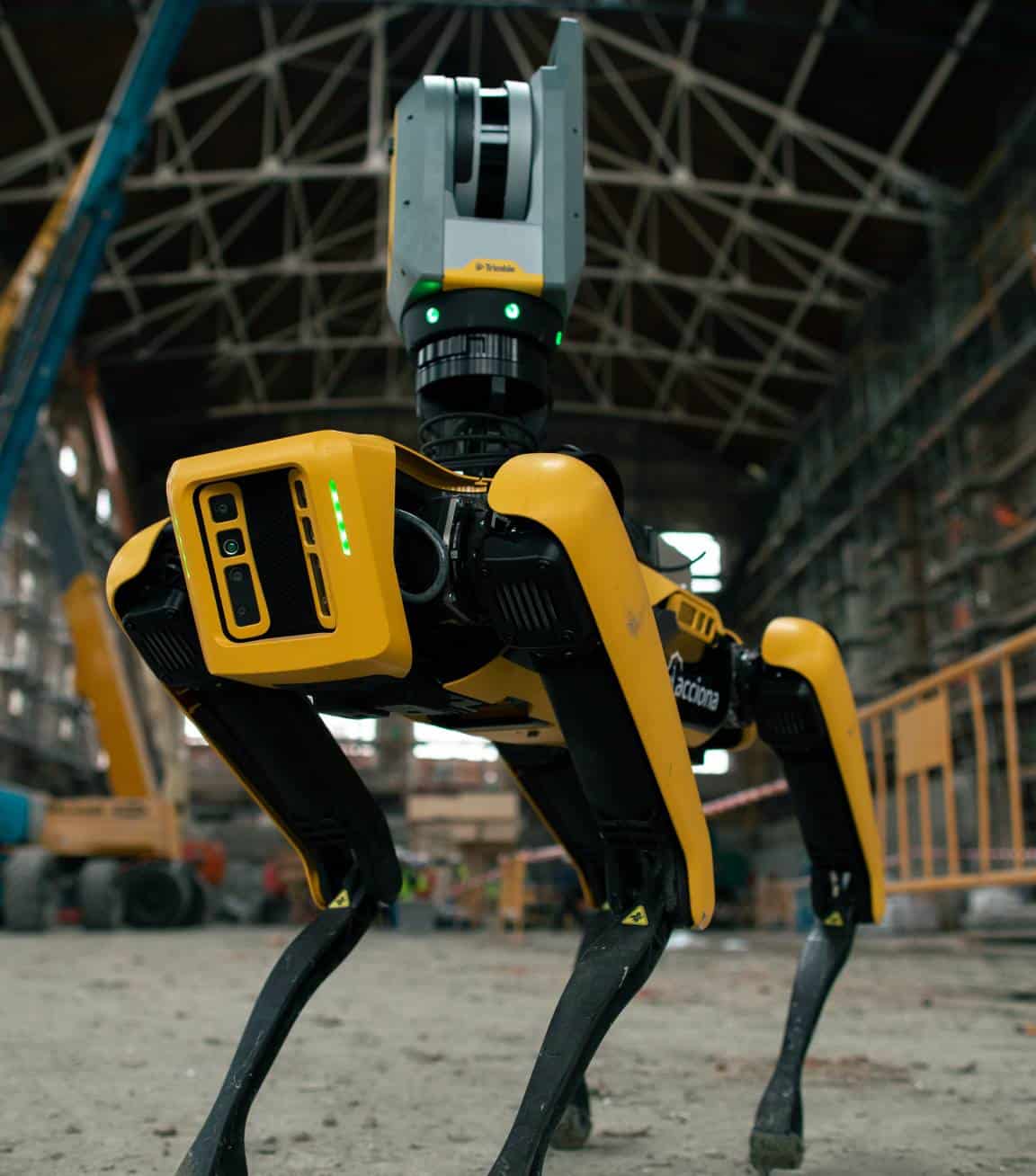
Spot and Atlas
Boston Dynamics is building humanoids that lift, and four-legged robots that survey. But the people who will decide what these machines are actually worth in the built world are not the engineers in Cambridge. They are the trade workers on site — and they should lead.

There are two robots worth watching in the built world right now, and they do opposite things. Spot, the four-legged machine from Boston Dynamics, has become a fixture on construction sites — not to build, but to record: automated data collection, site-progress monitoring, safety inspection. Mount a laser scanner on its back and Spot becomes a walking provenance instrument, capturing what the site actually looks like, day after day. Atlas, the company's humanoid, does the other half. Built for heavy industrial tasks, it has human-scale hands with tactile sensing, lifts up to 110 pounds, reaches seven and a half feet, and runs about four hours on swappable batteries. One robot watches the work. The other does it.
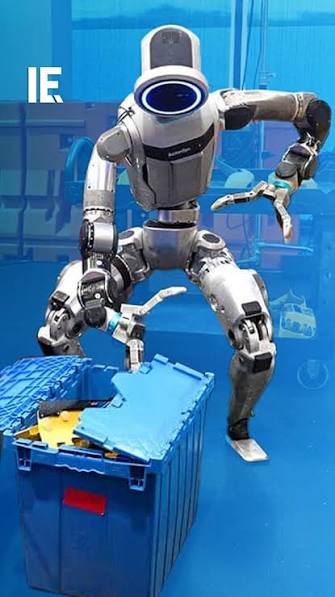
The machine supplies the labor. The trade supplies the judgment.
The thing that should reassure a skeptical electrician or ironworker is buried in how Atlas actually learns. It does not arrive knowing your site. Through what Boston Dynamics calls post-training, a human expert teaches it a new, site-specific task — often in under a day — and once learned, the skill is pushed across the whole fleet through their Orbit management software. Read that carefully. The robot is fast, tireless, and strong. But it is the human expert who decides what good work looks like, who demonstrates the correct sequence, who judges when the task is done right. The machine supplies the labor and the choreography. The tradesperson supplies the judgment and the authority. That distinction is not a comforting slogan — it is the actual architecture.
A humanoid on a job site is not the author of the work. It is a collaborator on the chain. The author is still the verified human who taught it, signed off on it, and stands behind the result.
Why the trades decide the value — not Cambridge
Boston Dynamics, backed by Hyundai through its AI Institute in Cambridge, is scaling toward factories capable of producing 30,000 Atlas units a year. That is an enormous bet on automated labor. But here is the part the press releases miss: the engineers can build the machine, and the financiers can fund it, yet neither of them gets to decide what it is worth on a real site. That decision belongs to the people who have always known whether a piece of work is sound — the trades. A robot that holds a tolerance an ironworker trusts has value. A robot that produces work the electrician has to redo has none, no matter how impressive the demo. The trade worker is the final inspector of the entire automation era.
Which is exactly why the trades should not wait on the sidelines to find out what happens to them. They should be the early adopters — the first to put Spot on their site, the first to teach Atlas a task, the first to say this works and this does not. The discipline that leans in early is the discipline that sets the terms. The one that hangs back gets the terms set for it. For two centuries the built world has rewarded the worker who picked up the new tool first and mastered it. The laser level did not replace the carpenter; the carpenter who learned it out-built the one who didn't. A humanoid is a bigger tool, but the logic is identical.
So let the humanoids lift and let the quadrupeds scan. The future of the built world is not humans versus machines; it is humans leading machines, with the trades out front deciding what earns a place on the chain and what doesn't. If we get this right, the most valuable signature on any build will still be the one a person puts on it — now standing behind not just their own hands, but the machines they chose to trust. Spot and Atlas are coming to the job site. The trades should meet them at the door, not behind it.