The Record Under the Road
The I-90 Allston project will untangle a highway, build a new transit station, and stitch a neighborhood onto a 90-acre railyard. Its financing rests on a question only a verified record can answer: did the built thing deliver the value we borrowed against?

Along the Charles River in Allston, where the Massachusetts Turnpike currently rides on a crumbling 1960s viaduct over an old rail yard, the state is preparing to do one of the hardest things in civil engineering: take a working highway apart and put it back together at ground level, without ever turning it off. The I-90 Allston Multimodal Project will straighten the Pike, replace the failing viaduct, build a new transit hub at West Station, and — almost as a byproduct — open up roughly ninety acres of former railroad land for an entirely new Boston neighborhood.
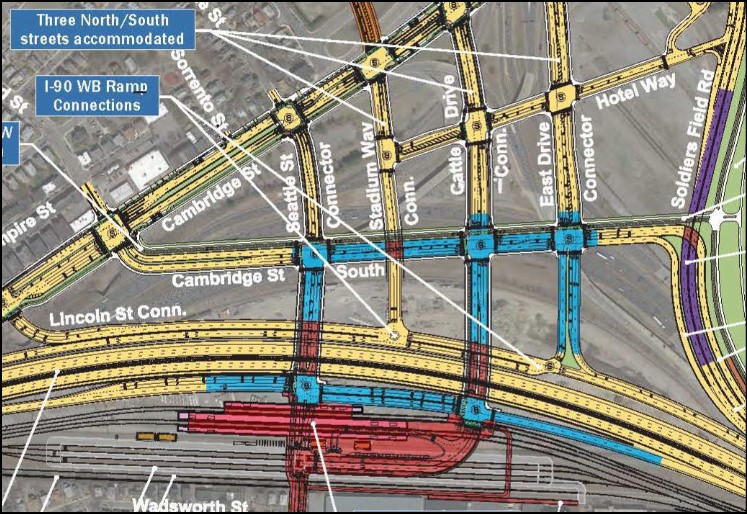
Look closely at the plan above and you are looking at the built world in miniature: three north-south streets threaded under highway ramps, a commuter-rail station dropped into the middle of it, connectors knitting Cambridge Street to Soldiers Field Road. Every yellow and blue line on that diagram is, in the end, thousands of discrete decisions made by thousands of people — a beam set by an ironworker, a deck poured by a concrete crew, a guardrail bolted into place, a drainage pipe laid to a spec and signed off by an inspector. A project like this is not one thing. It is hundreds of thousands of things, each made by someone, each installed on a date.
Who pays, and why it matters
What makes Allston unusual is not just the engineering. It is the money. The project is led by MassDOT and the City of Boston, but the funding stack reaches into the private and institutional world in a way that ordinary road projects do not. Harvard, which owns the Beacon Park Yards land and stands to capture enormous value as the new neighborhood rises, has pledged ninety million dollars. Boston University, an abutter, has pledged ten. And the City of Boston has committed two hundred million — roughly half of it through a value-capture mechanism: borrowing today against the future tax value that the project itself is expected to create.
That is the quiet revelation buried in the Allston funding plan. When a city issues debt against future value, it is making a wager on the built world's performance. The new streets have to carry the traffic. West Station has to move the riders. The neighborhood has to fill in, and the property values have to rise, or the bond does not pencil out. For decades, the only way to settle that wager has been projections, consultant reports, and trust. There has never been a neutral, permanent, un-editable record of what was actually built and whether it delivered.
We are the record of the built world — down to the cement. A value-capture deal is the purest proof that provenance is money.
— The Propreti thesis, applied to municipal finance
Every stone, on the record
This is where Allston stops being a Boston story and becomes the whole story. The built world builds the world's highways, tunnels, and bridges — and it does it one guardrail, one stone, one batch of cement at a time. Each of those components has a maker, a spec, an installation date, and an inspector who signed off. Today that record evaporates the moment the road opens. It scatters into binders, into the memory of crews who retire, into the silos of the contractors who happened to be on the job. And then forty years on, when a deck cracks or a guardrail fails, the most important question in the built world — what went in, who made it, who signed off — has no answer that cannot be disputed.
Allston will be built by exactly the crews already on this record. Heavy-civil teams of the kind boring beneath Boston Harbor will realign the Pike. Ironworkers will raise the new structure over the rail yard. The carpenters training a few miles away in Dorchester will frame the neighborhood that follows. None of them lacks skill. What the built world lacks is a place to keep the proof of their work — a ledger that belongs to the asset rather than to any one company, and that outlives every firm that touches it.
The ledger under the value
Imagine the Allston interchange not only as a set of ramps and platforms, but as a record: every component on that MassDOT diagram traceable to the maker who supplied it, the crew who installed it, and the inspector who attested to it — sealed, neutral, and permanent. The City borrowing against future value would have something no projection can offer: a verifiable account of whether the thing it financed was actually delivered. Harvard and BU, having put real capital in, would have proof of what their money built. And the public — taxpayers, advocates, the residents of the neighborhood to come — would have one record that no single party could edit after the fact.
That last point is the one that matters most, because Allston is contested terrain, as every great infrastructure project is. The state, the universities, the transit advocates, and the neighborhood do not always agree. Precisely because they are adversaries, they need a record none of them controls. Neutrality is not a feature here; it is the entire value. A ledger that flatters MassDOT or Harvard is worthless. A ledger that all of them are forced to trust, because none of them can rewrite it, is the missing infrastructure beneath the infrastructure.
We are not there yet — not for Allston, not for any project of this scale. The continuous, component-level record this vision describes is the built world's work for the next decade, as material certifications, sign-offs, and as-built data come online. But the Allston funding plan tells us the demand already exists. A city is already, today, financing a highway against verified future value. It is simply missing the ledger to hold that value against. The road will get built. The only question is whether, this time, we keep the record under it.
Verified in this story
The makers named above, connected to their verified work.