AI Designs Its Own Infrastructure: The Copper Cooling Breakthrough and the Future Memory of the Built World
AI is not simply software. It is becoming one of the largest drivers of physical infrastructure development in modern history — and the people building that foundation deserve a permanent, trusted record.

The recent breakthrough described in "Engineers Found a Genius Way to Slash Data Center Energy Use" highlights a reality that many people outside the technology sector rarely consider: artificial intelligence is not simply software. AI is becoming one of the largest drivers of physical infrastructure development in modern history.
As demand for cloud computing, machine learning, and generative AI continues to accelerate, data centers are expanding at an unprecedented pace. These facilities consume enormous amounts of electricity, generate significant heat, and require increasingly sophisticated systems to remain operational. According to industry forecasts, data center energy consumption in the United States may account for as much as 12 percent of the nation's electrical grid load by 2028.
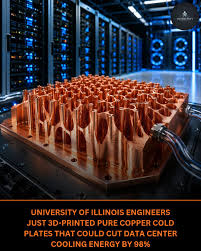
To address this challenge, engineers at the University of Illinois Urbana-Champaign, working with manufacturing firm Fabric8Labs, developed an innovative cooling technology using AI-assisted design. Their solution employs pure copper cold plates with jagged, highly optimized fins that increase surface area and improve heat transfer. Manufactured using advanced electrochemical additive manufacturing, these copper structures can provide up to 32 percent better cooling performance while reducing pumping power requirements by as much as 68 percent.
The innovation demonstrates something larger than a cooling breakthrough. AI is now helping redesign the physical infrastructure that supports AI itself. Computational systems are increasingly being used to optimize energy systems, manufacturing methods, and engineering designs that make future computing possible.
Yet the most important story may not be about technology alone.
The rapid expansion of data centers is creating one of the largest skilled-trades opportunities in decades.
Across North America, developers are racing to construct new facilities capable of supporting AI workloads. As a result, demand for electricians, HVAC specialists, welders, pipefitters, fiber optic installers, and mechanical technicians has surged dramatically. Labor shortages have become so severe that many workers in the data center sector earn 25 to 30 percent more than those performing similar work in traditional construction or industrial environments.
Electricians and power technicians are responsible for installing and maintaining critical power distribution systems, backup generators, switchgear, and uninterruptible power supplies. HVAC and cooling specialists manage chillers, computer room air conditioning units, and increasingly sophisticated liquid-cooling systems designed to prevent high-density servers from overheating.
Fiber optic technicians terminate and test thousands of miles of cabling that connect servers to global communications networks. Pipefitters and mechanical trades install chilled-water loops, fire suppression systems, and specialized plumbing infrastructure necessary to support next-generation cooling technologies.
Recognizing the shortage of qualified workers, major technology companies have begun investing directly in workforce development. Meta Platforms partners with Associated Builders and Contractors through America's Workforce Academy, providing accelerated training programs that can prepare workers for high-demand construction careers in as little as five weeks. The company also supports the LevelUp Fiber Technician Pathway, helping develop a new generation of network infrastructure specialists.
Google has launched its Skilled Trades and Readiness (STAR) Program, designed to introduce workers to careers in electrical, mechanical, construction, and fiber-optic fields that support digital infrastructure development.
These initiatives represent a significant shift in how technology companies view labor. For decades, Silicon Valley was associated primarily with software engineers and computer scientists. Today, some of the most critical contributors to AI infrastructure wear hard hats, operate welding equipment, install conduit, terminate fiber, and maintain cooling systems.
This convergence of technology and skilled trades raises an important question: how will the industry document, verify, and preserve the contributions of the people building the physical foundation of the AI economy?
Historically, much of the built world's knowledge has been fragmented across resumes, spreadsheets, project binders, permits, and disconnected databases. Valuable expertise is often lost when projects conclude and teams disperse.
Propreti was created to address that challenge.
As the emerging record-first network for the built world, Propreti seeks to preserve the records, relationships, and contributions that shape our physical environment. Rather than beginning with social interaction and adding records later, Propreti starts with evidence, work history, and project participation.
Founder and AI organizational theorist Ipyana Wasret explains the distinction simply:
Propreti is a record-first network with a social layer — not a social network that keeps records.
— Ipyana Wasret, Founder
That difference is significant.
A skilled electrician who helps commission a hyperscale data center. A welder who fabricates critical infrastructure. A fiber technician who installs thousands of network connections. An HVAC specialist who maintains advanced liquid-cooling systems. Each contributes to a larger story that deserves to be recorded, corroborated, and preserved.
As AI transforms the digital world, the built world is expanding alongside it. Data centers, power systems, cooling technologies, and communications networks will define the next generation of infrastructure. The organizations that succeed will not only build these systems efficiently; they will also preserve the knowledge, relationships, and trust that make them possible.